
Thailand DTV Visa Requirements 2026: New Rules From August 31
Thailand has introduced important changes to the Destination Thailand Visa (DTV) application process.
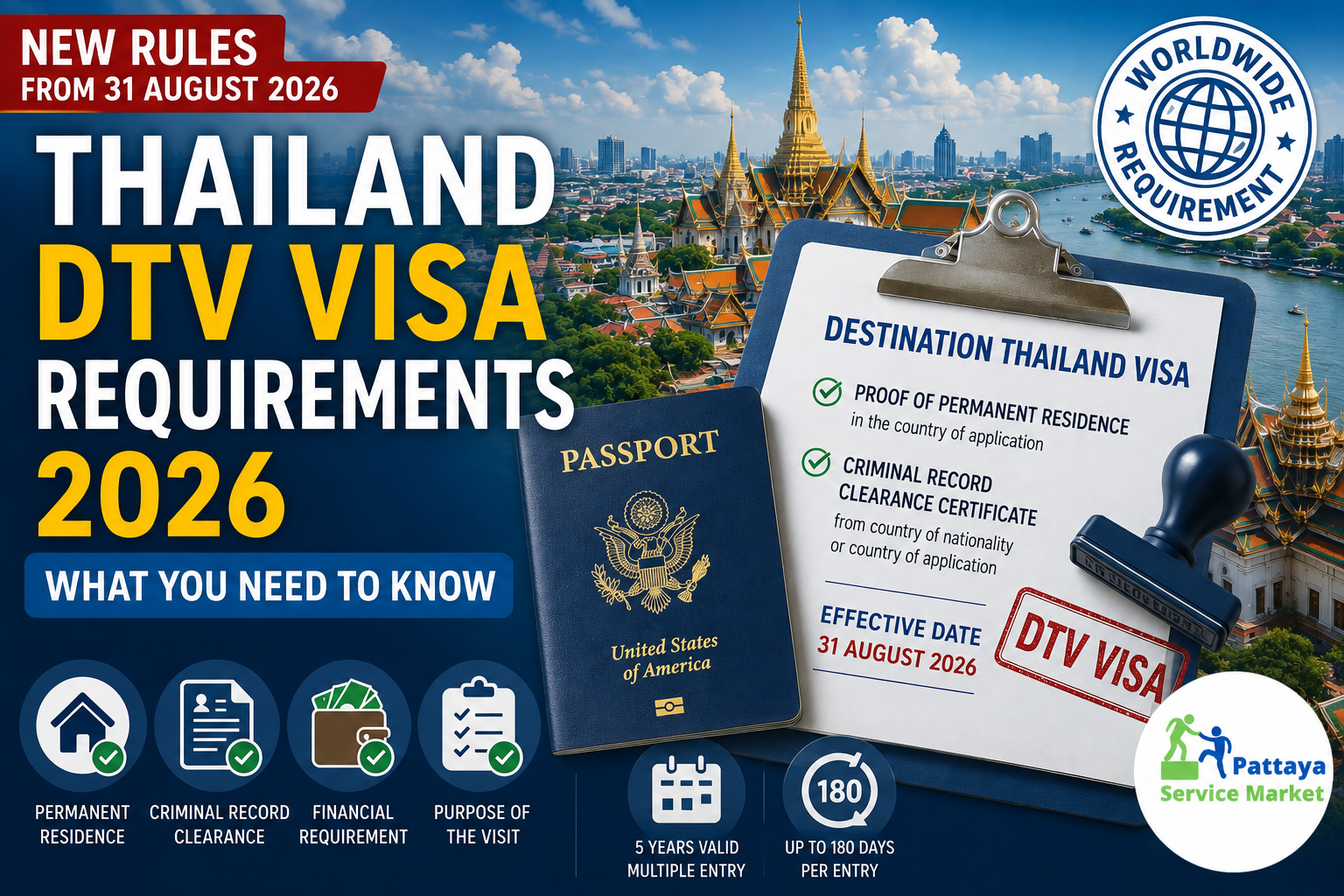
From 31 August 2026, DTV applicants must provide additional documents, including proof of permanent residence in the country where they submit their visa application and a criminal record clearance certificate.
The changes are especially important for foreigners who previously travelled to another country to apply for a Thai DTV while they were only temporarily staying there.
What Are the New Thailand DTV Visa Requirements for 2026?
The new Thailand DTV visa requirements 2026 introduce two major changes to the application process.
- Proof of permanent residence in the country where the DTV application is submitted.
- A certificate of criminal record clearance.
The Royal Thai Consulate-General in Savannakhet states that the new requirements take effect from 31 August 2026. Other Thai diplomatic missions, including those in London and Rome, have also published updated DTV requirements reflecting the same change.
This means the change is not limited to applicants using the Thai Consulate in Laos.
Do the New DTV Visa Rules Apply Worldwide?
Yes. The new policy affects DTV applications submitted through Thai embassies and consulates from 31 August 2026.
The Royal Thai Consulate-General in Savannakhet specifically states that the new requirement applies from 31 August 2026 and that applicants must be permanent residents of the country where they submit their visa application.
Other Thai missions have also updated their DTV requirements.
For example, the Royal Thai Embassy in London now requires proof of permanent residence in the UK, Ireland or British Overseas Territories. The Royal Thai Embassy in Rome requires proof of residency status in Italy, Cyprus, Albania or Libya.
The exact documents accepted can vary between Thai embassies and consulates.
Can You Apply for a Thailand DTV in Any Country?
No.
One of the biggest changes to the DTV visa application 2026 process is that applicants can no longer assume they can simply travel to another country and apply there.
You must have the required connection to the country where you submit your application, normally through nationality or permanent residence.
Can I Apply for a DTV From a Neighbouring Country?
This is one of the most important questions for foreigners currently living in Thailand.
In the past, some foreigners living in Thailand travelled to neighbouring countries such as Laos, Vietnam or Malaysia and submitted a DTV application there.
The new requirements make this much more difficult.
If you are only visiting a neighbouring country as a tourist, you should not assume that you can submit a DTV application there.
You would generally need to be a national or permanent resident of that country, subject to the requirements of the relevant Thai embassy or consulate.
Can I Apply for a DTV in Laos?
The Royal Thai Consulate-General in Savannakhet states that, from 31 August 2026, DTV applicants must be Lao nationals or permanent residents of Laos.
The applicant must also provide a criminal record clearance certificate issued by the authorities of Laos or their country of nationality.
This means that simply travelling to Laos for a visa application is no longer enough.
Can I Apply for a DTV in Malaysia?
You should not assume that you can travel to Malaysia as a tourist and apply for a DTV there.
The new worldwide policy requires applicants to meet the relevant nationality or residence requirements of the Thai mission where they apply.
Check the current requirements of the Thai embassy or consulate in Malaysia before making travel arrangements.
Can I Apply for a DTV in Vietnam?
The same principle applies to Vietnam.
If you are only temporarily visiting Vietnam, this does not automatically mean that you can submit a DTV application there.
You should confirm whether you have the required residence status before planning a DTV application in Vietnam.
What Does Permanent Residence Mean for a DTV Application?
The applicant must be able to prove the required residence status in the country where the DTV application is submitted.
This is different from simply being physically present in that country.
- Tourist visa
- Visa exemption
- Short-term visa
- Hotel booking
- Temporary stay
- Entry stamp
The exact document required to prove residence depends on the Thai embassy or consulate handling the application.
For example, the Royal Thai Embassy in London accepts documents showing permanent residence or qualifying long-term residence in the UK, Ireland or British Overseas Territories.
New DTV Visa Criminal Record Check Requirement
The second major change is the introduction of a mandatory DTV visa criminal record check.
From 31 August 2026, applicants must provide a certificate of criminal record clearance as part of their DTV application.
The Savannakhet requirements state that the certificate can be issued by the authorities of Laos or the applicant’s country of nationality.
Other Thai embassies may specify different acceptable certificates, so applicants should check the requirements of the specific Thai mission handling their application.
What Is a DTV Visa Police Clearance Certificate?
A police clearance or criminal record certificate is an official document used to confirm whether an applicant has a criminal record according to the issuing country’s records.
The name of the document can differ between countries.
For example, the Royal Thai Embassy in London refers to a police clearance certificate and gives the ACRO certificate as an example for applicants in the UK.
How Recent Does the DTV Police Clearance Need to Be?
The required validity period can depend on the Thai embassy or consulate.
For example, the Royal Thai Embassy in London requires the police clearance certificate to have been issued within six months of the DTV application.
Before requesting your criminal record certificate, check the requirements of the Thai mission where you plan to apply.
Does a Criminal Record Mean Your DTV Will Be Refused?
Not necessarily.
The new rule means that a criminal record clearance certificate is required as part of the application.
It does not mean that every applicant who has a previous conviction will automatically be refused.
The relevant Thai embassy or consulate will make the final decision and may request additional information or documents.
Applicants with previous convictions should expect that their application may require additional consideration.
Why Is Thailand Introducing a DTV Criminal Record Check?
The official announcements do not state that the DTV is being cancelled or that all applicants are considered high risk.
The new criminal record requirement gives Thai authorities additional information when assessing DTV applicants.
It also means that applicants should allow additional time to obtain their police clearance before submitting their application.
What Documents Are Required for a Thailand DTV?
The new documents do not replace the other DTV requirements.
Applicants still need to provide documents supporting the purpose of their trip and their financial situation.
- Passport biodata page
- Recent passport-style photograph
- Proof of the purpose of the visit
- Evidence of sufficient financial means
- Proof of permanent residence
- Criminal record clearance certificate
- Employment or freelance documentation where applicable
- Supporting documents for qualifying Thai soft power activities
How Much Money Do You Need for a Thailand DTV?
The DTV financial requirement remains at a minimum of 500,000 THB or the equivalent amount in the relevant currency.
The Savannakhet consulate lists bank statements covering the previous three months or a sponsor letter as examples of acceptable financial evidence.
The exact format of financial evidence can differ between Thai embassies and consulates.
Is the Thailand DTV Still Valid for Five Years?
Yes.
The new application requirements do not change the basic DTV validity.
- 5-year visa validity
- Multiple entries
- Up to 180 days per entry
- Possibility to apply for one extension of up to 180 additional days per entry
Can People Already in Thailand Apply for a DTV?
The DTV remains an option for eligible applicants, but the new application-location requirement is important for people currently living in Thailand.
If you are in Thailand and plan to leave the country to apply for a DTV, you should first confirm that you are eligible to apply through the Thai embassy or consulate in the country you plan to visit.
Simply leaving Thailand and entering another country does not automatically make you eligible to submit a DTV application there.
If you are already living in Thailand and want to review your available visa options, you can also visit our Visa Services Pattaya page.
What Happens to DTV Applications Submitted Before 31 August 2026?
The transition can be important for applicants who are preparing their application before the new requirements take effect.
Some Thai missions have specifically stated that applications submitted before 31 August 2026 will continue to be considered under the previous requirements.
The exact transition procedure can depend on the Thai embassy or consulate and whether the application has been properly submitted and paid.
What Should You Do Before Applying for a DTV?
The new DTV visa requirements 2026 make it more important to check your application location before making travel plans.
- Which Thai embassy or consulate will handle your application.
- Whether you are a national or permanent resident of that country.
- Which document proves your residence status.
- Which criminal record certificate is accepted.
- How recent the police clearance must be.
- Whether the certificate requires translation or legalisation.
- Whether you meet the financial requirement.
- Whether your employment or freelance documents support your DTV purpose.
- Whether additional documents may be required.
Thailand DTV Visa 2026: The Biggest Change for Applicants in Thailand
For many foreigners already living in Thailand, the biggest practical change is the restriction on applying through a third country where they are only temporarily present.
In the past, some foreigners could leave Thailand, travel to a neighbouring country and submit a DTV application there.
From 31 August 2026, you should not assume that this route will still be available.
If you do not have the required residence status in the country where you plan to apply, you may not qualify to submit your DTV application there.
Thailand DTV Visa Requirements 2026: Key Points
The new Thailand DTV visa requirements 2026 introduce important changes for applicants around the world.
- DTV applicants must meet the nationality or permanent residence requirements of the country where they apply.
- Proof of permanent residence is required under the new policy.
- A criminal record clearance certificate becomes a required document.
- The accepted police clearance document can vary between countries.
- The required validity period of the certificate can vary between Thai missions.
- Thai embassies and consulates can request additional documents or interviews.
- The DTV remains a 5-year multiple-entry visa.
- Each entry can provide up to 180 days of stay.
Need Help With Your Thailand DTV Application?
If you are currently living in Thailand and are considering a DTV application, it is important to check whether you can legally submit the application through the Thai embassy or consulate you plan to use.
Pattaya Service Market provides DTV Visa assistance in Pattaya and can review your circumstances before you decide how to proceed.
You can also visit our Visa Help Pattaya page for information about other Thai visa and immigration services.
Royal Thai Consulate-General, Savannakhet: Destination Thailand Visa (DTV)
Royal Thai Embassy, London: Visa Information and DTV Update
Royal Thai Embassy, Rome: Adjustment of Supporting Documents for DTV Applications
Official Thai E-Visa: Thailand E-Visa
Need Help With Your DTV Application?
Contact Pattaya Service Market for a free consultation and let us review your situation before you apply.
Frequently Asked Questions About Thailand DTV Visa 2026
What are the new Thailand DTV visa requirements for 2026?
From 31 August 2026, DTV applicants must provide proof of permanent residence in the country where they submit their application and a criminal record clearance certificate.
Do the new DTV visa rules apply worldwide?
Yes. The updated requirements are being applied by Thai embassies and consulates from 31 August 2026. The Savannakhet consulate explicitly states that applicants must be permanent residents of the country where they submit their application.
Can I apply for a DTV in another country while on a tourist visa?
You should not assume that you can. The new requirements require the applicant to have the required nationality or permanent residence connection with the country where the application is submitted.
Is a police clearance required for a Thailand DTV?
Yes. A criminal record clearance certificate becomes a required supporting document for DTV applications from 31 August 2026.
Which country should issue my DTV criminal record certificate?
The Savannakhet requirements state that the certificate can be issued by the country of nationality or the country where the application is submitted. The exact requirements should be confirmed with the Thai embassy or consulate handling your application.
How recent does my DTV police clearance need to be?
The required validity period can differ between Thai missions. For example, the Royal Thai Embassy in London requires a police clearance certificate issued within six months of the application date.
Can I still apply for a DTV in Laos?
Under the updated Savannakhet requirements, applicants must be Lao nationals or permanent residents of Laos.
Can I apply for a DTV in Malaysia as a tourist?
You should not assume so. You need to meet the nationality or residence requirements of the Thai mission handling your application.
Can I apply for a DTV in Vietnam?
The same principle applies. Simply being in Vietnam as a tourist does not automatically mean that you can submit a DTV application there.
Is the Thailand DTV still valid for five years?
Yes. The DTV remains a 5-year multiple-entry visa with up to 180 days permitted per entry.
Is the DTV being cancelled?
No. The DTV remains available for eligible applicants. The main change concerns the application location and additional supporting documents.
Does a criminal record automatically mean my DTV will be refused?
Not necessarily. The criminal record certificate is now part of the application requirements, but the final decision is made by the relevant Thai embassy or consulate. Additional information may be requested.
Can I apply for a DTV from Thailand?
The official Thai E-Visa system requires applicants to be outside Thailand when submitting an e-Visa application. If you are currently in Thailand, you should first determine which Thai embassy or consulate you can apply through under the new residence requirements.
Need Help With Your DTV Application?
If you are unsure where you can apply or whether you meet the new DTV requirements, contact Pattaya Service Market for a free consultation.
Keywords: Thailand DTV visa requirements 2026, Thailand DTV visa 2026, DTV visa requirements 2026, DTV visa criminal record check, DTV visa police clearance, DTV visa permanent residence, Thailand DTV application 2026, new DTV visa requirements, Thailand DTV visa changes 2026, DTV visa application from Thailand, DTV visa Laos, DTV visa Malaysia, DTV visa Vietnam, Destination Thailand Visa 2026, DTV visa criminal record, Thailand visa 2026