
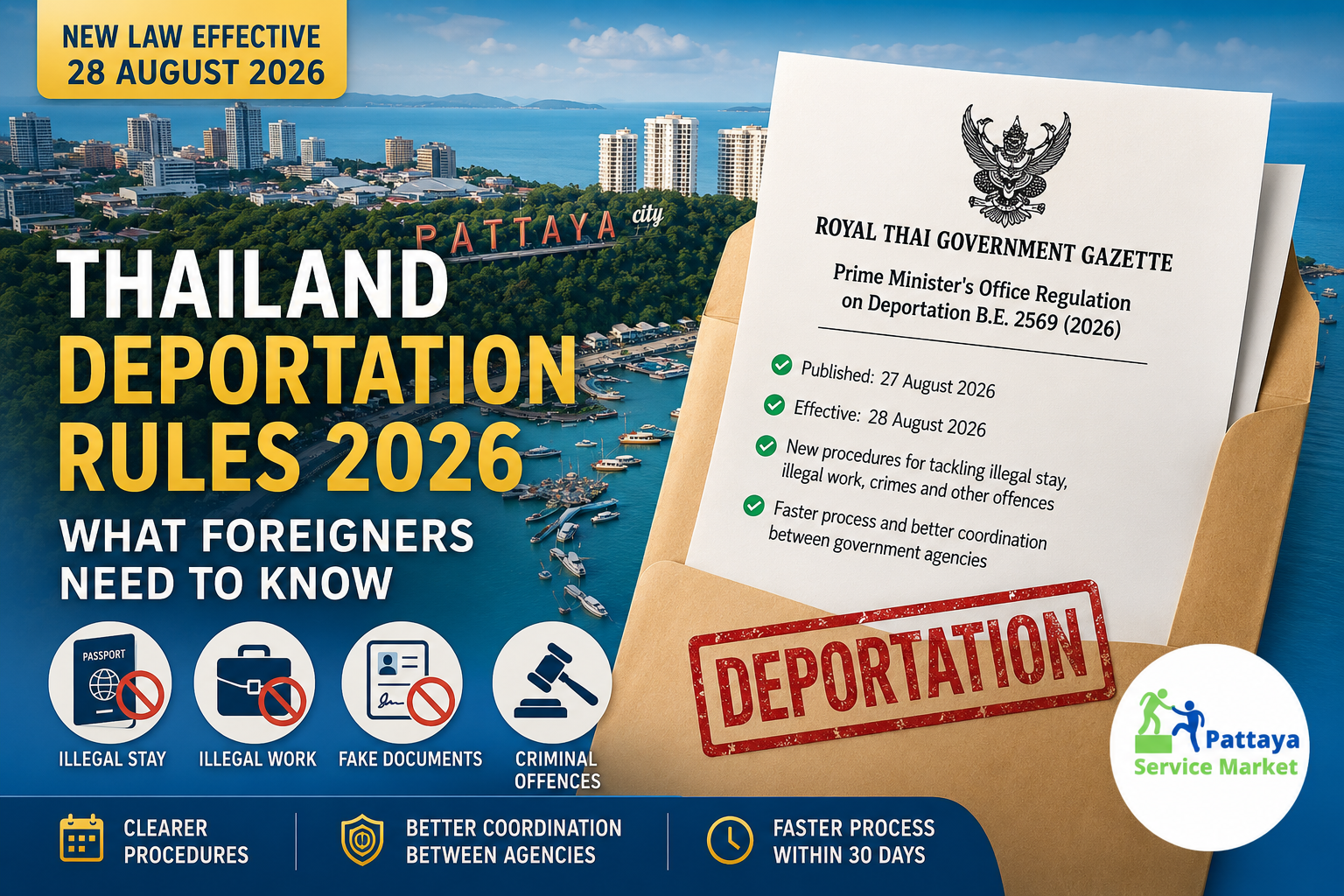
Thailand Deportation Rules 2026: New Deportation Regulation for Foreigners
Thailand has introduced a new deportation regulation for foreigners who enter or remain in the country illegally, work without proper authorization, commit certain offences or engage in conduct that may affect public order.
The Prime Minister’s Office Regulation on Deportation B.E. 2569 (2026) was published in the Royal Gazette on 27 August 2026 and came into effect on 28 August 2026.
The new Thailand deportation rules provide clearer procedures for government agencies when dealing with foreigners who may be subject to deportation.
Thailand Deportation Regulation 2026: What Changed?
The new regulation does not create an entirely new deportation system. Thailand already had laws allowing the deportation of foreign nationals.
The purpose of the new regulation is to establish clearer administrative procedures and improve coordination between government agencies involved in deportation cases.
The Thai Government says the new procedures are intended to make the process clearer and faster while reducing unnecessary delays.
Who Can Face Deportation From Thailand?
The new Thailand deportation rules 2026 identify six main categories of conduct that can fall within the deportation framework.
1. Entering or Staying in Thailand Illegally
The regulation covers foreigners who enter or remain in Thailand in violation of Thai immigration law.
This includes situations where a foreign national does not have valid permission to remain in Thailand.
This is particularly relevant to foreigners who are on visa or immigration status that has expired or has otherwise become invalid.
2. Working Illegally in Thailand
Foreigners who work in Thailand without the required authorization or in violation of Thai foreign worker laws can fall under the new deportation framework.
Foreigners working in Thailand should make sure that their immigration status and work authorization match the work they are performing.
3. Operating a Business Illegally
The regulation also covers foreigners who operate businesses in violation of Thai laws governing foreign business activities.
Running a business in Thailand without the required permissions can create both legal and immigration problems.
4. Forging or Using Fake Government Documents
Forging official government documents or knowingly using forged government documents is another category covered by the regulation.
Foreigners should always make sure that documents submitted to Immigration and other Thai government authorities are genuine and contain accurate information.
5. Certain Criminal Offences
The regulation also covers foreigners who commit offences under Thai law that carry imprisonment of three years or more.
The exact circumstances of the offence and the applicable Thai law will determine how the deportation provisions apply.
6. Acting as a Principal, Instigator or Supporter
The regulation also covers people who act as principals, instigators or supporters in relation to the offences described above.
Thailand Overstay and the New Deportation Rules
One of the most important questions for foreigners is whether a Thailand overstay can lead to deportation.
An overstay occurs when a foreigner remains in Thailand after their permitted period of stay has expired without receiving another valid permission to remain.
The new regulation specifically includes foreigners who enter or remain in Thailand illegally.
If you are currently on overstay, it is better to have your individual immigration history checked before deciding how to leave Thailand or apply for another visa.
Does a Thailand Overstay Automatically Mean Deportation?
No. The new regulation should not be understood as meaning that every foreigner who overstays will automatically be deported.
The regulation establishes procedures for dealing with foreigners who fall within the relevant categories.
The actual situation can depend on the length of the overstay, immigration history, previous violations and other circumstances surrounding the case.
A short overstay handled at the border is different from a long-term overstay involving other immigration violations.
Can You Be Deported From Thailand Without a Criminal Case?
The deportation framework is not limited to criminal convictions.
The Thai Government has also highlighted foreigners whose conduct is considered inappropriate, creates disturbances, fails to respect Thai law or culture, or causes problems for members of the public or other tourists.
The new regulation therefore gives authorities a clearer administrative framework for dealing with conduct that may be considered contrary to public order, good morals or public welfare.
Who Can Order Deportation in Thailand?
Under the new regulation, the relevant authority is the Minister of Interior.
Government officials can report cases to the Minister for consideration when a foreigner’s conduct falls within the applicable deportation framework.
The regulation also improves cooperation between government agencies, including the Ministry of Interior, Royal Thai Police, Immigration Bureau and Ministry of Tourism and Sports.
How Does the Thailand Deportation Process Work?
The new regulation is designed to improve coordination between government agencies before and after a deportation order is issued.
- Checking the foreigner’s circumstances and immigration status.
- Gathering information from relevant government agencies.
- Taking legal action where required.
- Considering whether deportation should proceed.
- Issuing a deportation order where applicable.
- Preparing the foreigner’s departure from Thailand.
- Returning the foreigner to the relevant country or another permitted destination.
How Quickly Can a Foreigner Be Deported From Thailand?
The new regulation is designed to reduce unnecessary delays between the end of legal proceedings and the deportation process.
The Thai Government has stated that when a deportation order has been issued and the foreigner does not have money to pay for their return journey, the government may consider using state funds for the journey home.
In those circumstances, the government states that the process should be completed within 30 days from the deportation order, subject to the applicable procedures.
Where Will a Deported Foreigner Be Sent?
The regulation provides procedures for returning deported foreigners to their country of nationality or another appropriate destination depending on the circumstances.
Some cases can involve a third country or another arrangement where this is permitted under the relevant procedures.
Does Deportation Affect Future Entry to Thailand?
Deportation can have serious consequences for a foreigner’s future ability to enter Thailand.
A deportation case is very different from a normal visa application or ordinary departure from Thailand.
If you have received a deportation order or believe you may be subject to deportation, you should have your individual immigration situation reviewed before attempting to return to Thailand.
Thailand Overstay 2026: What Should You Do?
If you are currently on overstay, do not assume that another foreigner’s experience will apply to your case.
- Your original entry date.
- Your permitted stay date.
- Any previous overstays.
- Your previous visas and extensions.
- Your immigration history.
- Any previous deportation or blacklist issues.
- Whether you have any outstanding immigration or legal matters.
If you are unsure about your situation, you can contact Pattaya Service Market for assistance checking your available options.
What Should Foreigners Living in Thailand Do?
The new Thailand deportation rules make it more important for foreigners to maintain valid immigration status and comply with Thai laws.
Keep Your Immigration Status Valid
Check the date you are permitted to stay in Thailand. Do not rely only on the visa expiry date because a visa expiry date and permitted stay date are not necessarily the same.
Avoid Overstay
If your permission to stay is approaching its expiry date, arrange an extension or departure before your permitted stay ends.
You can also review our Thailand visa services if you need assistance with an extension or another immigration option.
Work Only With the Correct Authorization
Make sure you have the correct work authorization before starting work in Thailand and that your work is permitted under your current immigration status.
Keep Your Immigration Documents Correct
Make sure your passport, visa, extension documents, TM30 information and other immigration records contain accurate information.
If you have questions about your residence registration, you can also read our guide about what happens if your landlord doesn’t submit TM30.
Get Advice If You Already Have an Immigration Problem
If you are already on overstay, have previous immigration violations or have been contacted by Immigration or another government authority, your situation should be assessed individually.
Thailand Deportation Rules 2026: Key Points
The new Thailand deportation regulation 2026 provides a clearer framework for government agencies dealing with foreign nationals who violate Thai law or fall within the specified deportation categories.
The regulation covers illegal entry or stay, illegal work, illegal business activities, forged government documents, certain criminal offences and people who assist or support these offences.
It also provides clearer procedures for cooperation between government agencies and the preparation of deportation cases.
The regulation does not mean that every foreigner who overstays will automatically be deported. The circumstances of each immigration case remain important.
Royal Thai Government Gazette: Prime Minister’s Office Regulation on Deportation B.E. 2569
Royal Thai Government: New Deportation Regulation and Government Procedures
Thai Government Public Relations Department: Thailand Enacts New Deportation Regulation
Need Help With Your Thailand Immigration Situation?
If you are concerned about an overstay, visa issue or another immigration matter in Thailand, contact Pattaya Service Market to discuss your situation.
Frequently Asked Questions About Thailand Deportation
What are the new Thailand deportation rules in 2026?
The Prime Minister’s Office Regulation on Deportation B.E. 2569 establishes procedures for deporting foreign nationals who fall into specified categories, including illegal immigration status, illegal work, illegal business activities, document forgery and certain criminal offences.
When did the Thailand deportation regulation take effect?
The regulation was published in the Royal Gazette on 27 August 2026 and became effective on 28 August 2026.
Can a Thailand overstay lead to deportation?
An overstay means remaining in Thailand without lawful permission and is included within the category of unlawful stay addressed by the new regulation. This does not mean every overstay automatically results in deportation.
Can illegal work lead to deportation from Thailand?
Yes. Illegal work is one of the categories covered by the new Thailand deportation regulation.
Can a foreigner be deported after committing a crime?
Certain criminal offences are covered by the regulation. The applicable law and circumstances of the case determine whether the deportation provisions apply.
Who can order deportation in Thailand?
The regulation gives the Interior Minister authority to consider and issue deportation orders within the framework established by the regulation.
Does an overstay automatically mean I will be deported?
No. An overstay is an immigration violation, but the new regulation does not mean that every overstay automatically results in deportation. The individual circumstances and immigration history are important.
Does deportation affect future entry to Thailand?
Deportation can have serious consequences for future entry. Anyone subject to deportation should check their individual situation before attempting to return to Thailand.
What should I do if I am already on overstay in Thailand?
You should have your immigration history and current situation checked before deciding how to leave Thailand or apply for another immigration status.
Need Immigration Assistance in Pattaya?
If you have questions about overstay, visas, extensions or other Thailand immigration matters, Pattaya Service Market can help you understand the available options.
Keywords: Thailand deportation rules 2026, Thailand deportation regulation 2026, Thailand deportation law 2026, Thailand overstay deportation, deportation from Thailand, deportation of foreigners in Thailand, new Thailand deportation rules, Thai deportation regulation, Thailand overstay 2026, illegal stay in Thailand, Thailand immigration deportation, deportation Thailand, Thailand immigration 2026